Le Centre Henri Lebesgue offre des contrats post-doctoraux pour des séjours de recherche au Laboratoire de Mathématiques Jean Leray à compter du 1er septembre 2014.
Dates limites :
Envoi du dossier de candidature : entre le 16 décembre 2013 et le 31 mars 2014.
Prise de fonction souhaitée : 1er septembre 2014.
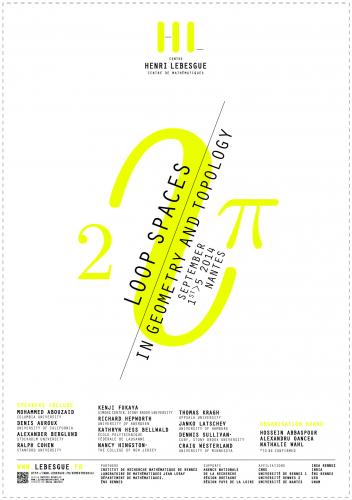
Nous pensons que le moment est propice pour rassembler des experts et des jeunes mathématiciens travaillant dans ces domaines. Nous nous attendons à de nombreuses interactions qui, nous l'espérons, pourront être une source d'inspiration pour de nouvelles idées. Dans cette optique, le programme de la conférence comprend cinq mini-cours destinés à un public de non-spécialistes, ainsi que plusieurs exposés portant sur des développements plus pointus.
Le programme de la conférence comprend cinq mini-cours destinés à un public de non-spécialistes, ainsi que plusieurs exposés portant sur des développements plus pointus. Mini-cours :
- Mohammed Abouzaid (Columbia Univ, New York)
- Kenji Fukaya (Simons Center, Stony Brook)
- Nancy Hingston (The College of New Jersey)
- Kathryn Hess Bellwald (École Polytechnique Fédérale de Lausanne)
- Richard Hepworth (University of Aberdeen)
Conférénciers :
- Denis Auroux (University of California, Berkeley)
- Somnath Basu (SUNY, Binghamton)
- Alexander Berglund (Stockholm University)
- Ralph Cohen (Stanford University)
- Thomas Kragh (Uppsala University)
- Janko Latschev (University of Hamburg)
- Dennis Sullivan (CUNY, New York/SUNY, Stony Brook)
- Craig Westerland (Univ. of Minnesota, Twin cities)
Si on a une algèbre de Lie sur un corps K, son opérateur de Koszul est l'application linéaire envoyant une 2-forme symétrique invariante B sur la 3-forme alternée invariante J_B(x,y,z)=B(x,[y,z]). Par restriction et composition, cela définit un opérateur vers la cohomologie en degré 3 de l'algèbre de Lie, appelé opérateur de Koszul réduit; dans le cas semi-simple c'est un isomorphisme (Chevalley-Eilenberg, Koszul). L'opérateur de Koszul réduit joue un rôle important dans la description Neeb et Wagemann décrivant la 2-cohomologie des algèbres de courant (c'est-à-dire l'algèbre de Lie sur K
obtenue par tensorisation avec une K-algèbre commutative). On donnera notamment des résultats d'annulation et de non-annulation de cet opérateur.
Les structures de contact et leurs cousines symplectiques permettent de jeter des ponts entre topologie et systèmes dynamiques.
– Recherche d’orbites périodiques de champs de vecteurs ;
– Étude des espaces de courbes holomorphes ;
– Liens avec la théorie des noeuds.
On présentera quelques enjeux et méthodes de la géométrie de contact.
Soutenance de thèse de François Mc Kee le 13 décembre 2013
Date de début de l'actualité
13-12-2013 14:00
Date de fin de l'actualité
13-12-2013 16:00
François McKEE soutiendra sa thèse de doctorat le vendredi 13 décembre 2013 à 14h00 à l'IFP School 232, Avenue Napoléon Bonaparte 92852 RUEIL-MALMAISON.
Spécialité :Mathématiques appliquées
Titre : Etude et mise à l'échelle des écoulements diphasiques en milieux poreux hétérogènes par une approche d'optimisation.
Le but de cet exposé est de donner quelques idées sur la collision de solitons
contre un potentiel non linéaire, et pouvoir quantifier le défaut d'élasticité
après la collision.